

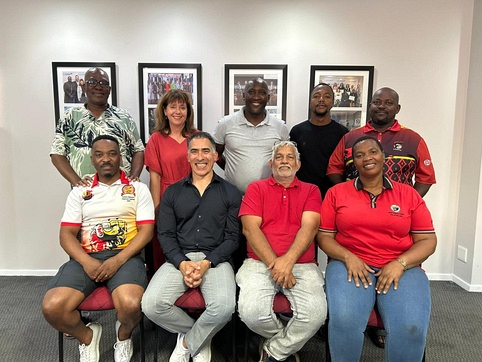
A step towards reshaping the future of work in Nelson Mandela Bay took place recently when the Nelson Mandela Bay Business Chamber convened an important engagement between business and leading labour formations to accelerate collaboration around the rapidly changing work environment. The Chamber emphasised that the metro’s economic challenges now demand shared, action-orientated solutions from organised labour and organised business, that can retain existing jobs while creating new opportunities in a rapidly shifting industrial environment.
As part of its key strategic direction, the Chamber has adopted an action-orientated approach to drive positive change in the Bay. This requires mobilising the business community and other stakeholders to drive the adaption, agility and actions required to ensure that businesses remain relevant and sustainable, so that they can employ people. Central to this effort is the establishment of a growing number of strategic partnerships at both local and national levels to unlock the metro’s full potential.
The session brought together representatives from COSATU, SAFTU, the Zanoxolo Wayile Foundation and Salie and Associates, alongside Jendamark Managing Director and Business Chamber Overall Local Economy Think Tank Co-Lead, Quinton Uren. The engagement explored how digital manufacturing, advanced technologies and automation can support economic recovery, strengthen competitiveness and unlock emerging forms of work which can be embraced by businesses operating in the metro.
With unemployment at record levels and local manufacturers being impacted by rising costs, technical skills shortages and the influx of cheaper imports into the markets, the Chamber noted that coordinated action between business and labour is now essential. Digitalisation was identified as a central lever for modernising production, rebuilding competitiveness and equipping workers with future-fit skills.
Addressing the meeting, Uren said: “Digitalisation is essential to safeguarding current jobs, improving productivity and restoring our global competitiveness. At the same time, it opens up completely new categories of work in engineering, systems integration, software development, analytics, maintenance and technology support. But for these opportunities to become real, we must deliberately and urgently invest in digital skills for our workforce.”
A key outcome of the engagement was a joint commitment to establish a business–labour steering committee early next year. The committee will focus on job retention, job creation, scarce skills development, youth employment and driving innovation across local industries. It will strive to serve as a critical mechanism for strengthening cooperation and ensuring that businesses in the metro are better positioned to adapt to technological shifts.
Founder and Director of Zanoxolo Wayile and former unionist, Zanoxolo Wayile, underscored the urgency of this work, saying: “The engagement forms part of a broader economic rescue effort in response to global shifts that are rapidly changing the world of work. We must urgently confront youth unemployment, the reskilling of retrenched workers and the growing mismatch between what young people are trained for and what industry, locally and globally, actually needs.
To do that, we need to strengthen partnerships, both globally and nationally. This includes leveraging BRICS relationships, as well as tapping into the resources and expertise offered by SETAs and the National Skills Development Programme to align skills training across sectors. We also need to introduce innovation and research hubs in communities, focused on early skills development, so that young people grow up equipped for modern, technology-driven workplaces.
Our aim is to prioritise interventions that can fundamentally shift the trajectory of our local economy. This requires bold, innovative approaches that reposition the metro for long-term competitiveness and opportunity.”
Uren emphasised that digitalisation must extend beyond the factory floor. “Although our focus was largely on industrial digitalisation, it became clear that digital transformation is needed across many sectors,” he said. “If you look at our productivity and skills levels nationally, compared to global standards, we have to catch-up and leapfrog to new areas of opportunity. So everyone must embrace this technology to gain an upper hand and to ensure they are not left behind. This engagement was the first real step towards business and labour working as a cohesive force for a better Nelson Mandela Bay.”
Nelson Mandela Bay Business Chamber Chief Executive Officer, Denise van Huyssteen, welcomed the momentum generated by the session and the active participation of the role players. She said: “This engagement demonstrates the potential opportunities for business and labour to work together in confronting the economic challenges facing our metro. Digitalisation is no longer optional - it is essential for protecting existing jobs, stimulating new forms of employment and strengthening Nelson Mandela Bay’s position as a hub of advanced manufacturing and innovation. The Chamber will continue driving collaborative initiatives that build competitiveness, develop critical skills and ensure our region is ready to take advantage of technology-driven growth.”
The Chamber will coordinate follow-up engagements in early 2026 as part of establishing the joint business–labour steering mechanism.
#ResurgingTheBay #BayOfOpportunity