

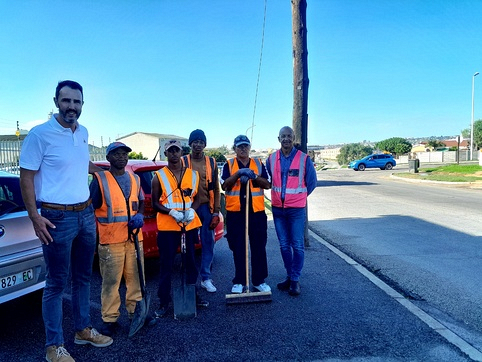
Businesses in Neave Industrial Park and Korsten are spearheading a clean-up initiative to enhance the area's aesthetic value, led by the Neave Korsten Cluster’s Henry Bennett Project. The initiative aims to address service delivery challenges in the Neave Industrial and Korsten areas, specifically focusing on Bennette Street and Henry Ford Road.
The cluster has partnered with MES (Mould Empower Serve), a social development organisation dedicated to providing sustainable solutions to poverty in urban areas like Johannesburg, Cape Town, Nelson Mandela Bay, and Kempton Park. MES runs the GROW programme, which empowers and rehabilitates the homeless by offering food, shelter, social work services, and job opportunities.
Initially started as a trial, the Henry Bennett Project has grown from involving four businesses to nine, with the goal of expanding to other areas within Neave Industrial and Korsten. The MES team has established a structured clean-up and maintenance plan that includes daily and weekly tasks such as verge cleaning, weed spraying, pothole repairs, road marking painting, and bollard replacement.
Project Coordinator for the Henry Bennet Project, James Flanagan, emphasises the project's potential for expansion and its positive impact on the community. Two permanent employees in Neave Industrial Park, who progressed through the GROW programme, are now employed by CPG Equipment, a local supplier of wheel servicing, brake, lifting, compressor, and air conditioning equipment to fitment centres in South Africa and beyond.
“The project was created on a trial basis in the area and the Cluster’s goal is to eventually replicate it in other areas within North End. Initially, the project started with only four businesses and the number has reached nine and counting. The MES team has established a daily and weekly clean up and maintenance plan focusing on the verges, weed spraying, covering potholes, painting of road markings, removing and replacing bollards,” says Flanagan.
Freek Myburgh, the founder and owner of CPG Equipment, got involved with the programme after learning about MES's work in the Metro. He highlights the opportunity it provides for individuals to prove their worth, work hard, and transition from the MES programme to independent living, thereby rebuilding their lives.
“I immediately got in touch with the team to see how we can assist. As such, we have two guys who now work for us and this has provided them with an opportunity to prove their worth, to work hard and to not simply give up. This also gives them a chance to move out of the MES programme and become independent as they rebuild their lives,” says Myburgh.
This initiative not only enhances the visual appeal of Neave Industrial Park but also fosters community development and empowerment through sustainable employment and rehabilitation efforts.
The Chamber’s Geographic Cluster Lead Paola Horak also highlighted the importance of the Henry Bennet Project and especially the collaboration with MES as an excellent example of good leaders who take ownership of the problems and collaborate to find solutions by harnessing synergies and taking positive action.
“Replication of this success story across the business clusters is key to resurging Nelson Mandela Bay,” says Horak.