

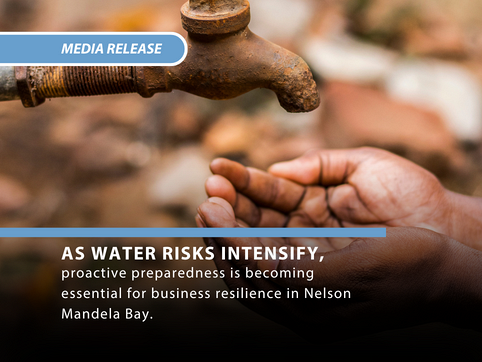
The Nelson Mandela Bay Business Chamber has encouraged businesses across the metro to strengthen their water preparedness by putting appropriate backup measures and solutions in place as dam levels continue to trend lower, the metro’s unaccounted water losses tracking at over 50% and water consumption continuing to remain above target.
“This combination of factors heightens the risk of water restrictions being implemented, and the potential for pro-longed periods of water-shedding to take place,” said Denise van Huyssteen, Chief Executive Officer of the Nelson Mandela Bay Business Chamber. “Businesses should be looking at water security as carrying a similar level of risk to what was experienced during the height of loadshedding in the 2023/24 period. This required that back-up solutions, such as solar power and generators, was in place to ensure business continuity during power disruptions.”
She emphasised that water security should be viewed as a shared ongoing responsibility that requires foresight rather than reactive measures.
The metro’s supply dams are currently tracking at 46.63%, with 37.64% of this being classified as useable. While this level may not indicate an immediate crisis, it does highlight the importance of proactive planning, particularly if dry conditions persist or demand continues to outpace replenishment. Current water usage is tracking at 378 million litres per day (MLD), compared to a target of 280 MLD.
“Water remains a critical input into every sector of the local economy from small businesses to large industries. With useable dam levels now below 40%, unaccounted water losses tracking at over 50% and consumption trending well above target, it is prudent for businesses to ensure they have reasonable contingency measures in place to manage potential interruptions,” she said.
Van Huyssteen noted that water conservation efforts remain essential and must continue, but added that conservation alone does not fully address operational risk.
“Responsible water use is fundamental, and businesses have made meaningful progress in this regard. However, experience has shown that conservation needs to be complemented by practical planning. Backup measures help businesses remain operational, minimise disruption and manage costs should supply constraints occur.”
She explained that previous periods of water stress in Nelson Mandela Bay had highlighted the value of preparedness, particularly for sectors such as manufacturing, tourism, hospitality, healthcare and small enterprises.
“Simple and appropriate interventions, such as water storage, recycling and reuse systems, or alternative supply arrangements where feasible and compliant, can significantly improve resilience without creating unnecessary strain on the system,” Van Huyssteen said.
She further emphasised that business preparedness contributes to broader economic stability. “When businesses plan responsibly, it supports continuity of employment, stabilises supply chains and reduces pressure on municipal response mechanisms during periods of strain.”
The Nelson Mandela Bay Business Chamber has encouraged businesses to review their water risk exposure, invest in proportionate backup infrastructure, fix leaks on their own premises and ensure compliance with all relevant regulations. The Chamber reaffirmed its commitment to constructive engagement with the various stakeholders to support transparent communication and long-term water security planning.
“Water security underpins economic confidence and sustainable growth,” Van Huyssteen concluded. “By acting early and responsibly, businesses can help ensure that Nelson Mandela Bay remains resilient, competitive and well-positioned to manage future water challenges.”
Chamber Water Task Team Lead Basil Mugwagwa said the current water outlook presents a critical moment for coordinated and practical action, particularly from the business community. “The combination of declining dam levels, persistently high consumption and structural losses in the system signals a growing risk environment that cannot be addressed through conservation alone. What the Chamber is advocating for is a balanced and responsible approach - continued water efficiency, coupled with realistic preparedness measures that protect business continuity and economic stability. By encouraging businesses to assess their water risk exposure and invest in proportionate and compliant backup solutions, we are not shifting responsibility away from the municipality, but rather strengthening collective resilience. Prepared businesses are better able to sustain operations, protect jobs and reduce pressure on municipal systems during periods of strain on the system. This kind of forward planning is essential if Nelson Mandela Bay is to remain economically competitive and resilient in the face of increasing water uncertainty.”
Water scarcity is not just a Nelson Mandela Bay or South African issue, but also a global issue. A United Nations Report, which was released this week and is titled Global Water Bankruptcy: Living Beyond Our Hydrological Means in the Post-Crisis Era, argues that the term “water crisis” fails to reflect today’s reality in many places around the world where people are living beyond their hydrological means. The report declares a new era of ‘water bankruptcy’, emphasising the need for urgent action and redefined policies to address irreversible losses.
#ResurgeTheBay #BayOfOpportunity