

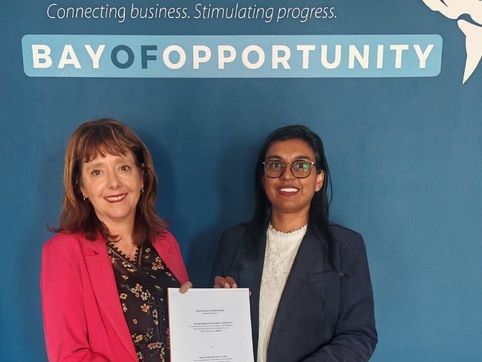
The Nelson Mandela Bay Business Chamber has entered into a Memorandum of Understanding (MOU) with Rabia Transitions to strengthen collaboration on advancing a Just Transition agenda that is socially inclusive, economically grounded, and responsive to the realities of industrial regions undergoing structural change.
The partnership will focus on developing practical, place-based approaches to Just Transition planning, with particular emphasis on socio-economic impacts such as employment shifts, skills development, industrial diversification, and community resilience. It will also prioritise joint research, thought leadership, and stakeholder engagement to support a fair transition toward a low-carbon economy.
Nelson Mandela Bay continues to emerge as one of South Africa’s most relevant test beds for Just Transition implementation, given its established manufacturing base and growing pipeline of green economy investments.
Key initiatives reinforcing this positioning include the Chamber’s Local Economy Think Tank Low Carbon Economy Hemp Project, aimed at unlocking new value chains in sustainable agriculture and bio-based manufacturing, as well as major green industrial developments such as multi-billion-rand green ammonia projects earmarked for the Coega Special Economic Zone.
Together, these developments and broader industrial transformation efforts within the metro position Nelson Mandela Bay as a critical site for demonstrating how heavy-industry regions can transition toward lower-carbon, diversified, and more inclusive economic models without undermining economic stability.
The MOU establishes a framework for cooperation between the two non-profit organisations, combining strengths in business leadership, systems thinking, and transition-focused research. The collaboration will support the development of analytical tools, policy insights, and practical frameworks that can be applied locally and in other comparable industrial regions across South Africa.
It also provides for joint exploration of research outputs, stakeholder engagement platforms, and potential funding mechanisms to support implementation-oriented work aligned with Just Transition principles.
Nelson Mandela Bay Business Chamber Chief Executive Officer Denise van Huyssteen said the partnership reflects a deliberate shift from concept to action in advancing place-based transition planning.
“This partnership with Rabia Transitions Initiative strengthens our ability to engage with the real economic and social implications of transition in a practical and grounded way.
Nelson Mandela Bay is not approaching Just Transition as an abstract policy concept. We are living it, through industrial restructuring, through new investment in green industries such as green ammonia at Coega, and through emerging value chains such as our Low Carbon Economy Hemp Project.
What this collaboration enables is a more structured way of linking business, research, and transition planning so that economic change is managed responsibly. It is about ensuring that as we shift toward a lower-carbon economy, we also actively support job creation, skills development, and industrial diversification in the region.
Importantly, this is about positioning Nelson Mandela Bay as a credible and practical demonstration site for Just Transition in action, where industrial policy, investment, and social outcomes are deliberately aligned.”
Rabia Transitions Founder and Executive Director Dr Chantal Naidoo said the partnership provides a critical opportunity to embed Just Transition principles within mainstream economic planning.
“The opportunity to work alongside the Chamber to practically embed principles of dignity and justice within economic diversification and low-carbon industrial development is truly valuable. The just transition needs to be embedded within mainstream investment logic and application. This collaboration allows us to amplify its place-specific and system-driven imperatives, which cannot be relegated to grant-based or side projects.
What makes Nelson Mandela Bay particularly significant is that many of the core tensions shaping South Africa’s transition narrative converge here in real time. It is a major manufacturing and port city with deep industrial capabilities and growing green economy investments, while at the same time facing significant pressures linked to inequality, unemployment, infrastructure vulnerability, climate risk, and economic restructuring.
We believe the realities emerging from Nelson Mandela Bay will inspire innovation in other industrial regions seeking approaches to transition that are capable of supporting both industrial transformation and social resilience.”
#ResurgeTheBay #BayOfOpportunity
Issued by:
Sibongile Dimbaza
Communications Officer