

The Nelson Mandela Bay Business Chamber views tonight’s State of the Nation Address as a pivotal moment for South Africa’s economic trajectory. Business is not looking for new commitments or expanded policy frameworks. It expects clear evidence that reforms are moving decisively from intent to implementation, supported by measurable progress and firm timelines.
South Africa’s prolonged low-growth environment, with growth below 1% and unemployment above 30%, reflects deep structural constraints. For the Chamber, the central test of tonight’s address is whether government demonstrates tangible progress in removing those constraints and restoring investor confidence.
Logistics reform must be front and centre. Export-driven sectors in Nelson Mandela Bay, particularly automotive manufacturing and agriculture, rely on efficient rail and port systems. The Chamber expects a clear plan to continue and accelerate the logistics improvements evidenced in the last year, which should incorporate expanded private sector participation.
Energy reform must continue with urgency. While load shedding has stabilised, transmission constraints, grid expansion delays and regulatory inefficiencies still inhibit new generation investment. The Chamber expects accelerated transmission rollout, regulatory certainty for private generation, effective wheeling frameworks and faster permitting processes. Energy security remains foundational to industrial stability and long-term investment.
Local government reform is equally critical. In Nelson Mandela Bay, deteriorating water, sanitation and electricity infrastructure directly threatens business continuity and deters investment. The Chamber expects decisive national intervention in addressing service delivery shortcomings, professionalisation of municipal administration, strengthened financial oversight and visible consequence management for governance failures. Infrastructure collapse at municipal level cannot continue to undermine national reform efforts.
Crime and corruption continue to erode competitiveness. Infrastructure vandalism, cable theft and organised criminal activity raise operating costs and disrupt supply chains. The Chamber expects strengthened investigative capacity, coordinated protection of strategic infrastructure and measurable prosecution outcomes. Confidence cannot be rebuilt without consistent accountability.
Fiscal discipline remains essential to macroeconomic stability. With public debt exceeding 70% of GDP and debt servicing costs crowding out productive spending, the Chamber expects a firm commitment to expenditure control and debt stabilisation. At the same time, growth-enabling capital investment must be protected. Infrastructure spending should prioritise economic assets that unlock productivity and competitiveness.
Government’s stated commitment of approximately R1 trillion to infrastructure over the medium term requires greater clarity. The Chamber expects defined project pipelines, transparent procurement processes, credible timelines and strengthened implementation capacity. Public-private partnerships in rail, ports, water and energy must be accelerated. Private capital is available, but it depends on bankable projects and regulatory certainty.
For Nelson Mandela Bay, the future of the automotive sector is of strategic importance. The Automotive Master Plan sets a 60% localisation target by 2035, yet current localisation levels have declined to between 30% and 40%.
The Chamber expects urgent correction of policy distortions to deal with the loopholes which currently make it attractive for semi-knocked-down assembly to be undertaken in the country. Alongside this the policy needs to more strongly incentivise completely knocked down assembly to ensure that meaningful manufacturing jobs are created
Incentive frameworks must prioritise localisation, supplier development, incentivise export growth and real domestic value addition. Production Rebate Certificate mechanisms should be reviewed to ensure they strengthen industrial capability. Localisation commitments must carry enforceable conditions.
Outdated tax structures that disadvantage local manufacturers should be addressed, alongside targeted technology incentives to modernise manufacturing plants and processes. Without policy agility, certainty and speed of implementation, South Africa risks further deindustrialisation and erosion of its automotive supplier base.
Regarding new energy vehicles, the Chamber supports a flexible, technology-agnostic policy approach. South Africa should accommodate battery electric, hybrid, hydrogen and alternative technologies to diversify its industrial pathway and export potential. Given limited domestic uptake, export competitiveness will remain critical.
Nelson Mandela Bay is positioned to leverage emerging hydrogen opportunities, particularly through the planned R100 billion Hive Hydrogen green ammonia development. With coordinated policy alignment and infrastructure readiness, this could help anchor advanced manufacturing and component localisation in the region.
Ultimately, the Chamber expects tonight’s address to demonstrate delivery. Infrastructure projects must move beyond announcement to execution. Municipal reform must be visible. Logistics performance must further improve. Industrial policy must adapt decisively and quickly to global realities.
Business in the Bay remains committed to collaboration. Investment capital and industrial capability are present. However, sustained investment depends on certainty, functionality and credible governance.
The State of the Nation Address must signal that South Africa has shifted from reform planning to reform implementation. Without accelerated delivery, growth will remain constrained. With it, the country can unlock investment, protect industrial capacity and create sustainable employment at scale.
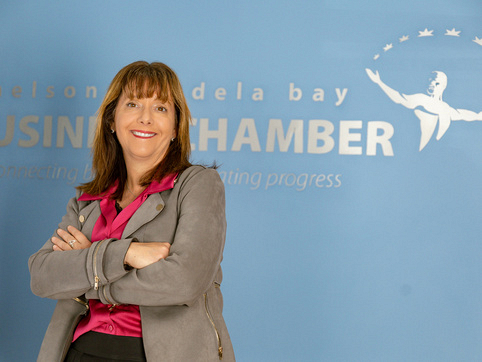
Denise van Huyssteen is the Chief Executive Officer of the Nelson Mandela Bay Business Chamber.
#ResurgingTheBay #BayOfOpportunity #MadeInTheBay