

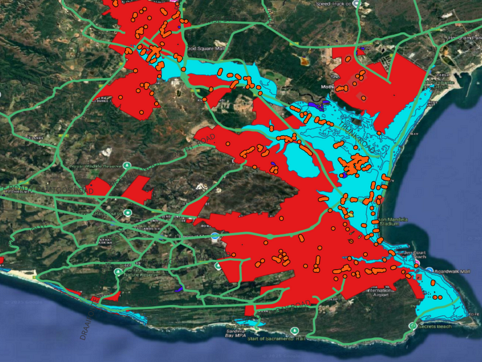
As climate-related disasters become more frequent and severe, the Nelson Mandela Bay Business Chamber is intensifying its commitment to strengthening the region’s resilience. Through its trailblazing Risk Management Desk, the Chamber has embarked on a critical mapping exercise to identify and understand high-risk zones across the metro, focusing on drought-prone areas, inland and coastal flooding hotspots, and the city’s stormwater drainage network.
This data-driven initiative, supported by advanced digital tools such as Google Maps and Quantum Geographic Information System (QGIS), is designed to enhance the city’s ability to anticipate and respond effectively to environmental threats. With weather-related incidents increasingly disrupting lives, businesses and infrastructure, the Chamber is leveraging technology and collaboration to build a clearer, more actionable picture of Nelson Mandela Bay’s vulnerabilities.
A key component of the project involves the collection and analysis of data to map the city’s stormwater drainage system. This enables a more accurate understanding of how water flows during heavy rainfall, where blockages occur, and which areas are most susceptible to flooding. These insights are vital to guiding mitigation strategies and infrastructure upgrades that can significantly reduce the impact of severe weather events.
Importantly, the Risk Management Desk’s mapping initiative forms part of a broader disaster readiness strategy that aligns with the work of the Business Chamber’s Disaster Management Task Team and supports tailored interventions within each of the metro’s 11 geographic clusters. Stormwater challenges and flood risks identified in these clusters are being used to guide the most critical focus areas. These include mapping pump stations, stormwater culverts, drains, illegal dumping sites, and other related infrastructure. Illegal dumping, in particular, has been identified as a major contributor to blocked drains. By linking specific dumping sites to the culverts they affect, the Chamber is ensuring that clean-up and prevention efforts are accurately targeted and resources are not wasted on areas that are not actively causing problems.
The Chamber’s Risk Management Desk is supported by Hollard Insurance, Santam, and Simah Risk Advisors, three organisations that share the Chamber’s commitment to fostering resilience through proactive, evidence-based planning.
Deanne Bezuidenhout, Hollard’s Head of Environmental, Social and Governance, explained that the company’s involvement stems from a belief that risk management begins with understanding. She noted that this mapping initiative enables stakeholders to foresee and reduce potential losses before they occur, and emphasised that Hollard sees this work as part of building systems and communities capable of withstanding future disasters.
Similarly, Santam’s Head of Market Development, Neptal Khoza, said that having witnessed the devastating effects of climate-related disasters, Santam recognises the value of shared data, coordinated planning and long-term resilience-building. He highlighted the importance of this partnership with the Chamber in enabling better protection for both people and businesses across the region.
From Simah Risk Advisors, Corporate Senior Account Executive Khanyisa Gogela stressed the role of strategic collaboration in building resilience. She explained that by supporting the Chamber’s initiative, Simah is contributing to a shared knowledge base that allows businesses and communities to plan more effectively, respond more quickly, and recover more sustainably. She noted that understanding the location and nature of vulnerabilities empowers stakeholders to address risks proactively, laying the groundwork for smarter infrastructure investment and more responsive emergency planning.
Denise van Huyssteen, Chief Executive Officer of the Nelson Mandela Bay Business Chamber, said the initiative is about much more than data collection - it is about creating informed, proactive strategies that protect lives, livelihoods and investments. She explained that with extreme weather events becoming increasingly common, it is critical to understand the city’s environmental vulnerabilities in detail. Through the Risk Management Desk, the Chamber is taking a proactive and data-led approach to risk assessment and identifying where interventions are most needed. This initiative, she said, enables the Chamber to map, monitor and ultimately mitigate risks before they escalate into full-blown crises.
Van Huyssteen added that having a clear view of high-risk zones and infrastructure gaps allows the Chamber, alongside the wider business community, to become an active partner in disaster preparedness. She emphasised the importance of driving real, measurable change that will improve the metro’s resilience, and expressed deep gratitude to the Chamber’s partners for enabling this essential work. She also called for further collaboration to broaden the impact of the initiative.
The mapping project is also closely tied to the Chamber’s upcoming drain-cleaning programme and its parallel initiative to ensure fire hydrants across the metro are fully operational. Both efforts will be guided by the mapping data to ensure maintenance and upgrades are focused on areas with the most urgent need.
The importance of this work has been highlighted by recent tragedies, such as the devastating floods in the Eastern Cape, which claimed 102 lives and severely impacted areas including the OR Tambo and Amathole districts. While Nelson Mandela Bay has not been spared the effects of extreme weather, the Chamber’s commitment to strengthening local disaster resilience offers hope through tangible, preventative action.
This initiative, led by the Risk Management Desk, marks a major step forward in building a safer, smarter and more responsive Nelson Mandela Bay.
#ResurgingTheBay #BayOfOpportunity