

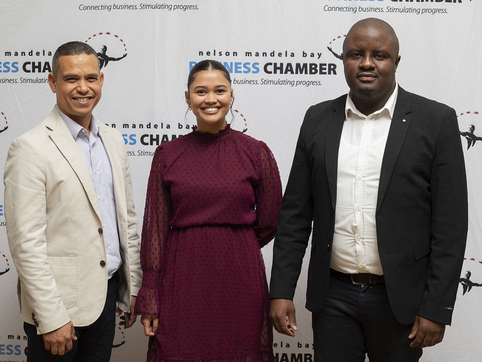
This week marks the second anniversary of the Chamber’s Entrepreneurship Desk which has grown exponentially since its launch in April 2022.
To date, 250 Micro, Small and Medium Enterprises (MSMEs) are registered with the Desk and receive tailored support to sustain their businesses for further growth and job creation. The businesses are 65% black owned, and 52% are female owned, and employ 1507 employees. They have a combined annual turnover of over R338 million.
Sponsored by Borbet SA and Standard Bank, the Desk acts as a single platform where business support, growth and sustainability initiatives are housed. This entails free access to legal consultation on commercial matters, various skills training workshops, networking events and business breakfasts, access to information sessions with various funding entities both private and public, and access to a dedicated resource that responds to their queries and continuously shares trade opportunities.
“Small businesses remain the backbone of the economy and play a critical role in terms of driving innovation, problem solving, job creation, contribution to the GDP, imports and exports, and local economic development. Through the Entrepreneurship Desk’s pro bono interventions, we have managed to support a cohort of sustainable and growing SMMEs who have received advisory support, skills enhancement, business-to-business linkages, and have been connected to various opportunities,” says Lunga Mjodo, the Chamber’s Business Information Manager. “We are very grateful to our members who are selflessly providing this type of support in order to help other businesses succeed, and for enabling the Desk to achieve this milestone of two years of operation.”
Mjodo further highlights that the Desk has also introduced the Entrepreneurship Accelerator Programme. “The programme is threefold, firstly it determines business gaps through business needs analysis; secondly, it provides entrepreneurial, leadership, and management skills development with a focus on the generic gaps identified; and lastly, it positions these MSMEs to access funding.”
The primary target MSMEs of the programme are businesses who have an annual turnover of R500 000 and have been in operation for a minimum of 12 months.
“It also focuses on compliance and growth matrix by identifying critical gaps within small businesses. This is an analytical approach designed to assess the strengths and weaknesses of Micro, Small, and Medium Enterprises (MSMEs), ensuring they meet regulatory requirements, develop growth strategies and identify areas that need improvement for sustainable growth,” says Mjodo.
The final stage of the programme involves positioning small businesses to access funding, which is achieved through collaboration with Standard Bank and the Small Enterprise Finance Agency (SEFA).
The programme is designed as a multi-stage process, moving from skills development to addressing compliance issues and finally positioning businesses for funding opportunities. The collaboration with Standard Bank shows commitment to providing tangible support for the growth and sustainability of small businesses in the Metro.
Standard Banks’s Executive Head, Business Clients Coverage Eastern Cape, Leigh-Anne De Witt, says that as a corporate partners with the Nelson Mandela Bay Business Chamber, they seek to attract, grow, enable and retain MSMEs through join initiatives to stimulate enterprise development.
“The aim of these programmes is to assist entrepreneurs to navigate the financial aspects of their business in both good and bad times. We would like to leverage our networks and specialists to assist entrepreneurs with access to markets, supplier development and trade finance to facilitate exports and imports, to name a few,” says De Witt.