
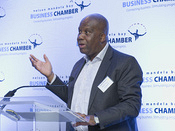
South Africa is currently operating in a radically different environment which requires out-of-the-box thinking, agility, resilience and collaboration, said Loyiso Dotwana, President of the Nelson Mandela Bay Business Chamber during the organisation’s Thirteenth Annual General Meeting held today at the Southern Sun Hotel, in Nelson Mandela Bay.
Dotwana said the country was at a tipping point where everything was coming to a head at the same time, both at a national and local level. “Our country is in a very serious state, with extreme loadshedding now the norm and our rail system, ports and roads all in a dismal state. Couple this with the political drama which has unfolded in many of the countries Metros and Municipalities which has included this metro.”
He highlighted that since 2016 Nelson Mandela Bay has faced political instability with coalition governments coming and going, along with this 6 different Mayors. “Furthermore, since 2016 the Municipality has had 12 acting City Managers. It is therefore no surprise that this all has had a detrimental impact on the administration of the metro and the delivery of basic services.”
“We face an economic survival crisis which requires all of us to pull together for the greater good of our local economy and jobs. This is not the time for political or personal agendas to determine the way forward. Rather, we should focus on being transparent about what the issues are and how can we solve them as a united front.”
He further elaborated that the interventions were not about organised business attempting to take over the role of government or the Nelson Mandela Bay Municipality, but rather about the involvement and action of all the relevant stakeholders to save investment and jobs through this emergency period. “The Chamber remains apolitical and will work with stakeholders and partners who will do the right thing.”
Chamber CEO Denise van Huyssteen highlighted the areas where collaboration between business and various stakeholders had achieved some success in the past year, among which included the following:
- The approval by City Council of a Master Adopt A MOU which opens the door for business to collaborate with them in solving issues which impact upon businesses.
- The 24 hour stage 5+ voluntary loadshedding schedule, which is a collaborative initiative between the Chamber and the Municipality, to enable better predictability and continuity for the operations of manufacturers. So far 35 businesses have qualified to partake in this intervention.
- The initiation of the Chamber’s trailblazing renewable energy cluster which represents 20% of the Metro’s current electricity usage.
- The growth in geographic clusters, run under the umbrella of the Cahmber, as a way for businesses to group together to address common issues. These include Perseverance, Struandale, North End, Kariega and Deal Party, while Neave/Korsten recently came on stream.
- The establishment of a property cluster to Identify and unblock obstacles which are impeding existing investments in the Metro.
- The Adoption of 19 Sub-Stations, geared at protecting this critical infrastructure from vandalism.
- The adoption of 76 schools where leaks are being fixed and water conservation solutions are being implemented.
- Adopt A Leak which saved the Metro over 1.5 million litres of water per day.
- The strong positive outcome of the Chamber’s legal case against NERSA, which essentially restricts municipalities from adding on additional increases as a result of their own inefficiencies.
- The initiation of a multi-stakeholder Nelson Mandela Bay Climate Change Coalition, with a particular focus on building a climate resilient metro.
- The signing of a Memorandum of Understanding between the Chamber and Naamsa to enable closer cooperation which will benefit the automotive industry, which forms the backbone of the Metro’s local economy.
Dotwana highlighted that while it was pleasing that the country’s regulatory environment around independent power generation has been eased, there is more which still needs to be done to accelerate renewable energy adoption. “A major concern we have is that renewable power which is initiated from any location in the country simply goes back to the national grid. Our view as the Chamber is that what the business community invests at its own cost, must directly benefit the Metro as a whole.”
“As we bring more power onto the grid, this should directly reduce levels of loadshedding for our entire metro.”
He said that in terms of water and sanitation, the Metro, like most others around the country, faced huge issues and much of this related to aging and poorly maintained infrastructure. “As part of our collaborative approach, we have offered the Municipality technical skills through the broad Adopt-A-MOU currently in place.”
“We have also prioritised lobbying local government for solutions to address vandalism on key infrastructure including electrical substations, water pump stations, sanitation pumps and railway lines.”
Dotwana said that logistics was another critical issue, which represents one of the highest cost areas for business. “We are the most manufacturing intensive metro in the country and to support our ongoing survival, we need efficient road, rail and ports infrastructure. Our metro has a huge advantage of two ports and if these ports become more efficient and the rail corridor between the North and South becomes functional again, then we can really turn the Nelson Mandela Bay into a world-class logistics hub for imports and exports,” he emphasised.
He also highlighted that climate change was a critical priority and that the Chamber is currently collaborating with various stakeholders to implement a climate change plan for Nelson Mandela Bay, to be directed at ensuring that climate change resilient infrastructure is in place and that the green economy becomes a key job generator for the Metro.
Van Huyssteen said that the past year has been an exceptionally difficult period for business and has required that the Chamber continue to pursue an activist and action-orientated approach in working with whoever will collaborate with for the greater good of our local economy. “As organised business, we do not believe that whining solves anything and that we should rather focus on what’s within our control and take action where we can. On this score we are very appreciative of the high levels of volunteerism which is growing within our local business community and which is directed at pulling together to save investment and jobs.”
Dotwana emphasised that all the stakeholders need to come together to form a new type of social compact. “This must be focused on re-building our country and metro for the benefit of all. There is so much potential and together we can tap into this.”