

South Africa’s tourism sector has been described as “buoyant”, having bounced back from the drastic slump under global Covid-19 restrictions and now exceeding pre-pandemic levels of employment numbers, economic contribution, and domestic tourist spending.
Nelson Mandela Bay, however, is not claiming its share, with local numbers telling a different story of under-recovery and untapped potential
This matters, not only now in September as Tourism Month, but year-round.
One in 18 jobs nationally are directly in tourism, over 950 000 people employed. With an estimated x2.5 multiplier effect on jobs in provision of goods and services to tourism businesses, this could add up to as many as 2.3 million jobs.
Over 180 000 new jobs were created in tourism nationally in 2024 alone.
The sector directly contributed 4.9% (R361.7 billion) of GDP in 2024, larger than the individual contributions of utilities, agriculture, or construction.
While the number of people working directly in tourism nationally has recovered to practically double the sharp decline of 2020, there is no evidence of a similar trend in Nelson Mandela Bay.
Direct and indirect employment in tourism in the Bay is estimated at 18 500 jobs, lagging behind the metro’s proportion of the national economy and population, and lagging the multiplier effect.
Estimated overnight visitor expenditure in the Bay was approximately R6.2 billion in 2025, and this 3.16% contribution to the metro’s economic value added is small in comparison to the contribution of manufacturing, trade and various services sectors, and in contrast to tourism’s out-performance of other sectors at national level.
Overnight visitors and airport volumes have not recovered to pre-Covid levels.
Chief Dawid Stuurman International Airport has not made significant gains in terms of the post-pandemic recovery, with passenger volumes in 2025 at 89% of 2019 numbers.
The NMB municipality’s figures for domestic tourist overnight stays last year were down 46% from 2019, from 2.75 million to 1.47 million, and foreign visitors overnighting down by 17%, 307 000 to 253 000.
A tough economy globally and locally, and a lack of disposable income for travel, are certainly among the reasons for under recovery in tourism.
Yet, global tourism and South Africa’s other key tourist destinations continue to grow, while Nelson Mandela Bay’s lack of growth can largely be attributed to pre-existing conditions that have declined further since Covid-19.
The list is long – instability and revolving doors in local government leadership and management, the severe decline in maintenance of public infrastructure and tourist attractions, rising crime and security concerns, fragmentation of tourism management and destination marketing, a lack of integrated packages that encourage longer stays.
The Bay has incredible assets in its natural environment, built environment, multi-cultural influences, heritage in the arts, manufacturing, agriculture, sport, and the role of its people and places in the liberation struggle – all stories waiting to be told.
These are not being sufficiently preserved or presented for future generations to understand, nor leveraged to deliver memorable tourist experiences that translate into local economic opportunity and job creation.
We can no longer blame a global pandemic of six years ago for current shortcomings.
The friendliness and warm hospitality of the people of the Bay, along with a favourable climate and natural beauty, can only carry us so far.
Tourism needs to be taken much more seriously.
Far preferable is for the stakeholders of diverse legacies and natural assets is to collaborate to coordinate key offerings and position Nelson Mandela Bay as a tourist destination, and get those responsible for the enabling environment to take accountability and act.
As a highly labour-intensive sector with strong multiplier effects through diverse economic sectors, making tourism work has a ripple impact into business in transport, retail, arts and culture, personal services, financial services, through to real estate and construction.
These strong economic and job creation impacts are the reason next month that the NMB Business Chamber, under the banner of our Bay of Opportunity initiative, will be launching a Tourism Economic Development Desk.
The Desk will integrate with the work of our geographic clusters supported by the Chamber’s task teams, and our other action-oriented desks focused on skills development, trade and investment promotion, and small business support.
This is a membership led and business-focused initiative, with the intention to work with, complement and support existing tourism organisations, to integrate and facilitate collaboration and practical outcomes where we can.
The Chamber has a solid track record in lobbying and advocacy on behalf of business to unlock obstacles in the enabling environment, in rallying member businesses who work together voluntarily to make a difference to shared challenges, and in gathering diverse stakeholders constructively around a politically-neutral table.
It is those strengths that we will bring to the Tourism Economic Development Desk, to support our members in the tourism sector and to tap into the tourism potential of the Bay, so that those businesses can grow and in turn, strengthen their contribution to the local economy and employment.
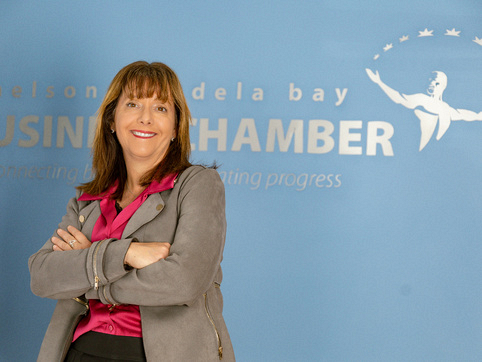
Denise van Huyssteen is Chief Executive Officer of the Nelson Mandela Bay Business Chamber.