

I am often asked questions on the lines of: “What more can we as organised business do to get better leadership in the metro, to secure delivery of more efficient municipal services – as business interests seem to be disregarded, particularly in terms of the critical investment and job opportunities which they retain and create.”
I deeply understand the frustration.
The metro’s leadership and governance shortcomings, lack of accountability, and the systemic issues crippling municipal administration and service delivery are well documented and diagnosed. The results of an inability to take action, spend available funds and implement plans are evident across the Bay.
In this vacuum of leadership and action, many organisations and individuals – from neighbourhood watches, schools, community and environmental organisations to the broad-based Civil Society Coalition and the NMB Business Chamber and its geographic clusters – are stepping up, cleaning up and fixing up.
At the Business Chamber’s Annual General Meeting last week, the people of the Bay were described as our “hidden asset” – working together even while competing in business, crossing traditional divides between business and organised labour, diverse communities and interest groups collaborating for the good of the people of the metro.
While the Business Chamber has been recognised for our proactive, solution-driven stance, there is also criticism in some quarters that we are “trying to run a parallel municipality” or want to take over the job of local government.
Nothing could be further from the truth.
As organised business, what we really want is for the municipality to succeed, to be the best-run one in the country, and we are prepared to put our time, expertise and resources into helping it to get there.
We want the NMB Municipality to be so good at delivering a functional enabling environment, that our members can get on with the business of doing business, and we can put our energies into attracting investment and creating jobs.
Both locally and nationally – through the business-government partnership in Operation Vulindlela – business is providing technical expertise and driving solutions and reforms, not because we have an interest in propping up a failing state, but because working to create a functional state is in the best interests of business and the people of the country.
However, as Business Leadership SA CEO Busi Mavuso highlighted at business events in the Bay last week, there is a risk of creating a dependency, of government simply handing over its obligations to business.
This is why the political problems – unstable coalitions, poor and unqualified leadership, lack of accountability – must be solved through both the ballot box and local government reforms; at the same time as business and civil society try and hold the line.
This is a crucial distinction.
Business can offer practical support to restoring infrastructure and service delivery, and participate as a stakeholder in public processes such as consultations on the local government white paper – as the Chamber is doing – but we cannot solve problems at a political level.
The simple answer to that lies in the ballot box for the local government elections on 4 November. It all goes down to having the right people with the right skills in the right roles, and very importantly who are there to serve the greater good of the metro.
However, those choices are out of our control, and we choose to rather focus on what’s within our control.
The Business Chamber has long held fast to being an independent, non-partisan organisation, focused on working in the best interests of business irrespective of which political party may be in power. As the voice of business, we do not align to any party or political agenda and, most importantly, our views and influence are not for sale.
The Business Chamber is a member of, and strongly aligned with, the Nelson Mandela Bay Civil Society Coalition.
The unity of purpose in this broad-based coalition – including NGOs, churches, organised labour, organised business and other, diverse stakeholders – driving accountability and action along common priorities through the signing of a joint social compact, illustrates the power of a “whole of society” approach to bringing about change that leaves no one behind.
It is through the efforts of this coalition that we have seen the parliamentary portfolio on cooperative governance, the Minister of COGTA and National Treasury turning the spotlight on accountability, leadership and governance of the NMB municipality.
Across the Bay, businesses are making a practical difference through the 11 geographic clusters, by participating in technical task teams supporting municipal officials on electricity quality and reliability of supply and the sanitation system, and by adopting substations, schools, clinics, pumpstations and traffic lights to secure infrastructure and address water conservation.
Our lobbying and advocacy efforts are putting the challenges and opportunities of the Bay on the national agenda, presenting solutions and actions around the infrastructure management crisis, de-industrialisation and other areas of concern.
These are just some examples that form the answer to the question of what business CAN do.
We will not give up on Nelson Mandela Bay. We believe this is the most fixable metro in the country.
We believe a vibrant civil society, is essential to rebuilding and unlocking the potential of this place we all call home.
We can stand on the sidelines and watch what other people are doing to bring positive change in this metro, or we can also sign up, show up, and BE the agents of the change we want to see in the environment around us.
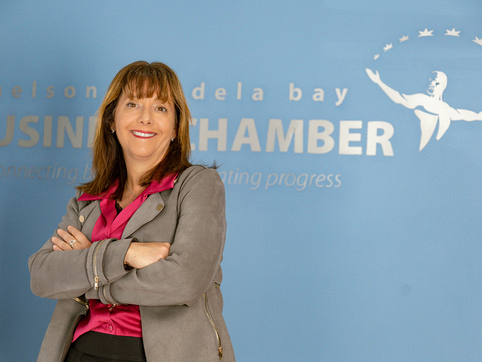
Denise van Huyssteen is Chief Executive Officer of the Nelson Mandela Bay Business Chamber.